
Car Wash Roofing Planning
Car Wash Roofing Built for Lubbock's Wash Corridors
Express tunnels and in-bay autos have multiplied along 82nd Street, Slide Road, and the 4th Street stretch near Texas Tech, where commuter traffic and the dust that blows in off the Llano Estacado keep wash volume high nearly year-round. We roof those buildings for what actually happens inside them, not for what a generic retail flat-roof spec assumes. A wash building is the most chemically hostile structure most of our crews ever work on, and the damage usually starts on the underside of the deck where nobody is looking.
The problem with a car wash roof is that the attack comes from below. Heated water, detergent fog, tire-shine solvents, drying agents, and rust inhibitors atomize during every cycle and rise into the deck cavity. That warm, saturated, slightly alkaline air condenses on the cold underside of the metal deck and on the shanks of the fasteners holding the assembly together. Over a few seasons the fasteners back out, the deck flutes corrode, and the insulation above them turns to mush, all while the top surface of the roof still looks intact from the parking lot. By the time a stain shows on the tunnel ceiling, the structural deck has often already lost section.
Why Tunnel Bays Need Their Own Membrane Spec
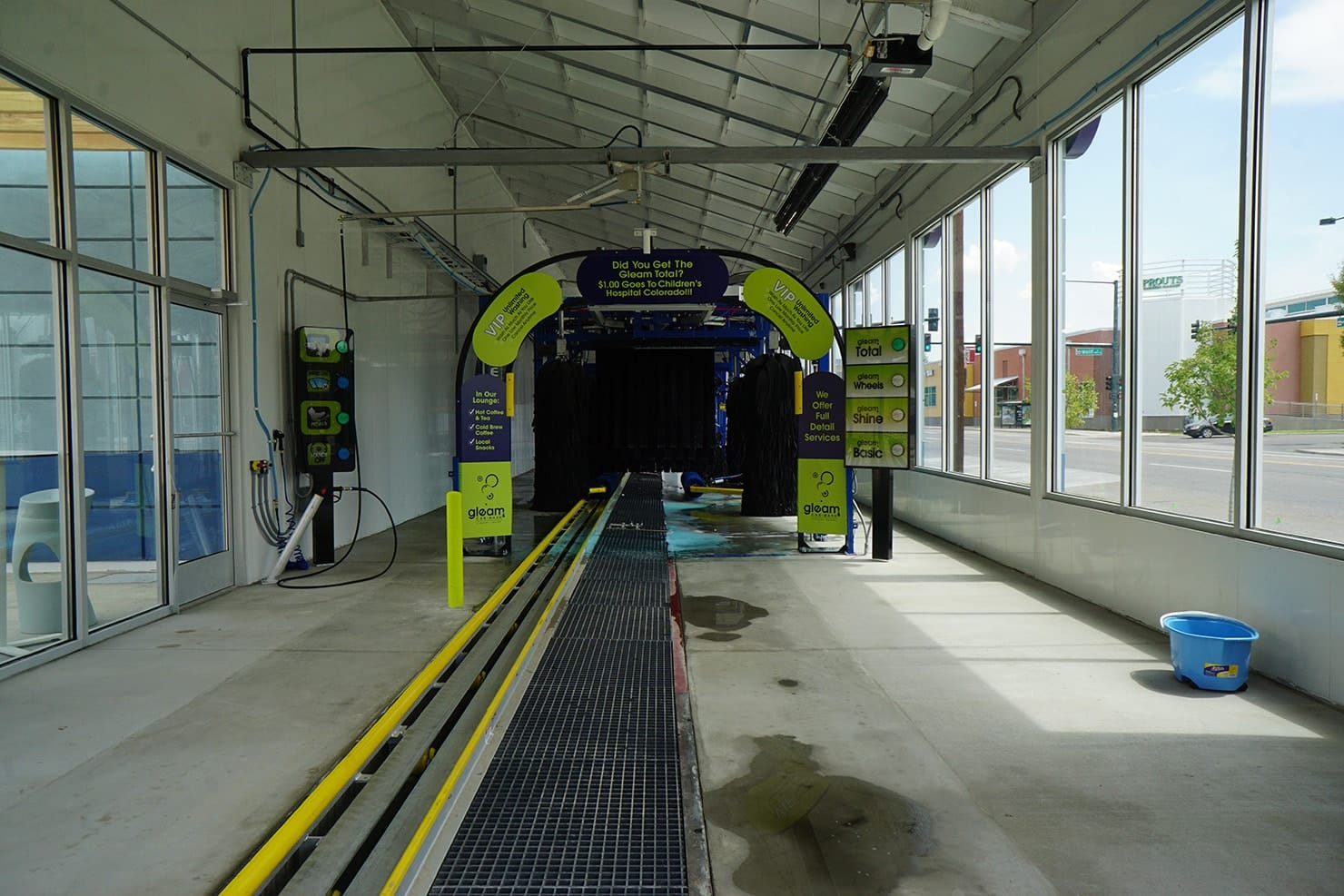
We treat a wash building as three different roofs that happen to share a parapet. The tunnel bay over the active wash equipment is the punishing zone, and it is where we spend the most attention.
For the tunnel bay we lean toward PVC or KEE single-ply. The plasticizer chemistry in PVC holds up against the alkaline detergents and wax compounds far better than TPO or EPDM, both of which can stiffen, craze, or lose seam strength under sustained chemical fog. We fully adhere or use a fleece-back attachment in the tunnel so the membrane does not flutter under the positive air pressure the blowers create and so we are not driving a fastener field through the most vapor-saturated part of the deck.
Stopping the Vapor Drive From Below
Membrane selection alone does not solve a car wash roof. The vapor drive is the real enemy, so the assembly has to manage it. Over the tunnel we specify a vapor retarder on the warm side of the deck, mechanically fastened or adhered insulation chosen so we are not creating cold-side condensation traps, and a high-volume exhaust strategy coordinated with the wash equipment so the worst of the moisture leaves the building before it ever reaches the deck. On a re-roof we core the existing assembly first; if the deck has already corroded or the insulation is saturated, a recover only buries the failure and we say so up front.
Vacuum Canopies and Pay-Station Coverings
The free-vac canopies on the exit side of every Lubbock express wash are a separate failure pattern. They are usually metal or membrane-clad steel frames, exposed to vehicle exhaust, overspray, and the wind loading that the open South Plains throws at anything standing in a parking lot. The two spots that leak are the canopy-to-building transition and the internal canopy drains. We re-flash those transitions, rebuild the drain connections, and check the gutter and downspout runs that carry water away from the vacuum islands. Where a canopy ties back into the main parapet, that joint gets detailed as its own flashing, not lumped into the field membrane.
Drainage, Penetrations, and the Exhaust Stacks
In-bay automatics and self-serve bays carry less chemical fog than a full express tunnel, but they almost always have drainage problems. Low-slope bay roofs pond over the equipment, and standing water above a humid bay accelerates everything happening underneath. We add tapered insulation to move water to drains or scuppers and we size new drains for the real roof area, not the original undersized layout. The tunnel exhaust fans that pull steam out of the wash get oversized curbs and chemical-rated flashing, because standard HVAC curb details are not built to sit in a continuous vapor plume.
Most washes on Slide Road and 82nd Street run seven days a week, so we plan the work around the cycle instead of asking an owner to close. Tunnel-bay membrane work happens in the early-morning or late-evening window when the conveyor is down. Lobby, equipment-room, and canopy work can usually proceed during business hours with traffic control that keeps cars clear of the staging zone. Every section is dried in watertight before the next wash cycle starts, so a half-finished roof never sees a West Texas thunderstorm.
Warranty Coverage That Actually Applies
Most single-ply warranties carry a chemical-exposure exclusion in the fine print, which means a standard warranty on a car wash tunnel can be worth nothing the day a claim is filed. Before we specify anything, we confirm with the manufacturer that the exact chemical program running in the building is compatible with the membrane and that the warranty will hold under those conditions. Several manufacturers offer chemical-exposure or wash-specific warranties, and we pursue those for the tunnel zone so the coverage matches the environment.
Questions Lubbock Car Wash Owners Ask
Which membrane do you put over a wash tunnel? A fully adhered or fleece-back PVC or KEE single-ply, because it resists the alkaline detergents and wax that degrade TPO and EPDM and because the adhered attachment avoids a fastener field through the most vapor-loaded part of the deck.
My ceiling is rusting but the roof looks fine. Why? That is the classic car wash pattern. Chemical-laden humidity is condensing under the deck and corroding it from below. The fix is a vapor retarder, a corrected exhaust strategy, and often deck repair, not just a new top layer.
Do you handle the vacuum canopies too? Yes. Canopy covers, their internal drains, the gutters, and the canopy-to-building transitions are all in scope. Those transitions are the most common chronic leak on an express wash.
Can you re-roof without closing the wash? In almost every case. We work the tunnel during off-hours and the rest of the building during the day, drying in each section before the next cycle.
Next Step
Send the building address, roof age if known, leak photos or condition photos, roof access notes, tenant limits, and the decision timeline. We will shape the roof walk around tenant activity, roof access, safety planning, and the operating schedule below the work and return a practical scope tied to what can be verified.