
Movie Theater & Cinema Roofing Planning
Movie Theater and Cinema Roofing in Lubbock
Lubbock's cinema business clusters where the people are, around the South Plains Mall, along the 82nd Street and Slide Road retail belt, and near the entertainment draw of Texas Tech in the central city. The multiplexes and entertainment buildings in those corridors share a roofing challenge most commercial buildings never face: they are mostly empty volume covered by very large clear-span decks, with seating and screens that demand the roof keep sound out and conditioned air in. We roof these buildings for their structure, not for a retail-strip generic pattern.
The first thing that defines a cinema roof is the span. A multiplex with eight to twelve screens carries auditorium bays of 80 to 150 feet with no interior columns, and those long spans deflect under wind and snow loads in ways a short retail bay never does. A fastener pattern copied from a strip-center roof concentrates point loads at the seams of a deflecting deck and tears itself apart over time. We set fastener density and insulation attachment from the actual deck type and the actual span, after we confirm both.
Long-Span Decks Need a Matched Attachment
Cinema construction is usually steel deck or concrete deck over structural steel framing, and each substrate needs its own approach.
On any cinema reroof in Lubbock we start with a core sample to confirm the existing insulation layers, the moisture content, and the total weight in place before we decide between a recover and a full replacement. Burying a wet assembly under new membrane only hides the failure.
Sound and Insulation Across a Big Deck
A theater roof is also an acoustic and thermal surface, and that shapes the assembly. A large low-slope deck over a quiet auditorium has to keep rain noise from intruding during a feature and has to hold conditioned air against the swings between scorching South Plains summers and cold, windy winters. We build up insulation to meet cool-roof energy code and to give the deck the thermal mass and rigidity that helps with both heat loss and sound transmission, rather than treating a cinema roof as a thin commercial cap.
Rooftop HVAC Density Like a Hospital
The mechanical load on a multiplex is dense and concentrated. Each auditorium typically runs a dedicated rooftop unit, and on top of that the building carries concession exhaust, lobby heating vents, and condensers for the walk-in coolers serving food service. The penetration cluster over a Lubbock multiplex rivals what we see on a hospital. Every curb, duct penetration, and conduit run gets flashed and documented as its own item before new membrane goes over it, and we add reinforced walkway pads on the heavy-traffic paths service crews use to reach the units, because foot traffic is one of the top causes of premature membrane failure on a theater roof.
Marquees, Canopies, and Entry Transitions
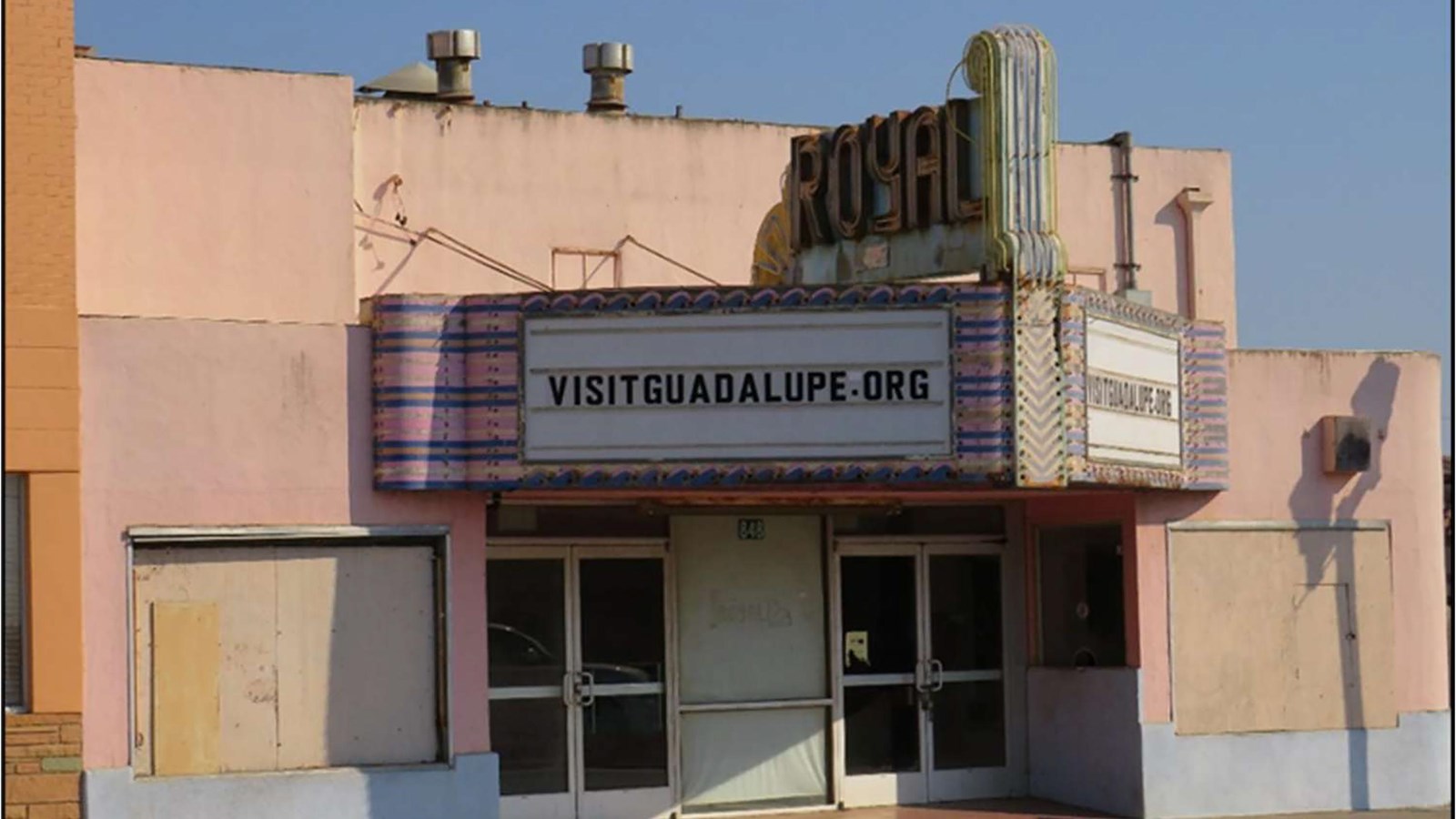
The marquee sign and the entry canopy are chronic leak sources on older theaters. Wherever a sign support or canopy framing penetrates the membrane, we treat it as an individual flashing rather than field membrane, and we re-flash the canopy-to-building transitions at the entrance, which are the joints that fail first. On a building whose street appeal sells tickets, a stained lobby ceiling or a dripping entry is a business problem, not just a roofing one, so those details get the attention they deserve.
Drainage Across Acres of Flat Deck
The flat low-slope roof over a multiplex is large enough that drainage is one of the biggest factors in how long the membrane lasts. Decades of deflection and settlement leave dead-flat areas that pond after every rain, and standing water bakes the membrane in the summer sun and adds weight the deck was not meant to hold. We design tapered insulation to move water positively to the drains and scuppers, size the drainage for the real roof area rather than the original undersized layout, and add overflow scuppers where code and good practice call for them so a clogged primary drain during a heavy South Plains downpour does not pond water over an auditorium. Ponding correction is usually the single change that most extends the service life of a theater roof.
What a Leak Over an Auditorium Costs
A leak in a theater rarely shows up as a small drip in a back room. It shows up over the seats, over the screen, or into the projection and sound equipment, and any of those stops ticket sales in that auditorium until it is fixed. The screen and the electronics are expensive and unforgiving of water, and a stained ceiling over paying customers is a reputation problem on top of a repair bill. That is why we build the assembly and the flashings to keep water out the first time and why we keep emergency dry-in capability ready for the building, so a sudden storm cell off the caprock does not turn into a closed auditorium on a Friday night.
Working Around the Show Schedule
Theaters run afternoon through late night, seven days a week, which puts them in the same scheduling category as a 24-hour building. We sequence tear-off and dry-in so each section is watertight before evening screenings begin, and we coordinate any HVAC shutdown needed for curb or penetration work with facilities management so it lands in a window that does not collide with showtimes. Loading-dock access for service contractors and evening foot traffic at the entries both factor into how we stage the work.
Questions Lubbock Theater Operators Ask
What do you put on a multiplex roof? Most often 60-mil or 80-mil TPO mechanically attached over tapered polyiso, with walkway pads at the HVAC service paths. Tapered insulation corrects the ponding that builds up on flat theater roofs over decades and the white membrane meets cool-roof code.
How do you handle the long auditorium spans? We verify deck type and gauge, run pull-out testing where needed, and choose fastener density to match. On deflection-prone bays we may go adhered or hybrid to keep point loads off the seams.
Can you reroof without closing the theater? Yes. We work around the screening schedule, dry in each section before evening shows, and coordinate any HVAC downtime with your facilities team.
Will you fix the leak at our entrance canopy? Yes. Marquee and canopy penetrations and the canopy-to-building transitions are re-flashed as individual details on every cinema project we do.
Next Step
Send the building address, roof age if known, leak photos or condition photos, roof access notes, tenant limits, and the decision timeline. We will shape the roof walk around tenant activity, roof access, safety planning, and the operating schedule below the work and return a practical scope tied to what can be verified.