
Commercial Solar Roof Integration Planning
Why the Membrane Has to Come First Out Here
Lubbock gets roughly 260 sunny days a year sitting up on the Llano Estacado at almost 3,200 feet, and that high-altitude sunshine is exactly what makes rooftop photovoltaics pencil out for commercial owners across the city. The trouble is the order in which the decisions usually get made. By the time we get a call, a solar contractor has often already measured the array, sized the inverters, and handed the owner a production estimate, and the roof underneath is treated as an afterthought that just needs to be cleared for racking. We push back on that, because a panel field is a 25-to-30-year fixture and the membrane it bolts to frequently has far fewer years left. Get the sequence wrong and you pay for it twice.
The buildings where this comes up most are the ones with broad, uninterrupted low-slope roofs. We are talking about the distribution and logistics boxes ringing the Interstate 27 and Loop 289 industrial belt, the agricultural and food-handling facilities tied to the cotton economy that anchors this part of West Texas, and the flat-roofed retail along the Slide Road and South Loop commercial corridors. A lot of that inventory carries single-ply or aging built-up roofs that simply will not see the back half of an array's service life. Our first deliverable is an honest read on how much life that roof actually has left, in writing, before anyone commits to a solar contract.
Run the Numbers on the Roof, Not Just the Panels
The financial logic is straightforward once you account for the roof. Mounting an array on a membrane with seven or eight years left means that when the roof gives out, every panel, rail, and conduit run has to be detached, stacked aside, and reinstalled after the tear-off and rebuild. On a mid-size commercial system that detach-and-reset evolution routinely costs tens of thousands of dollars and knocks the array offline for weeks of lost generation right in the middle of its productive life.
When the existing roof is already past its midpoint, reroofing now and landing solar on a fresh assembly almost always wins on total cost of ownership. We hand owners a documented remaining-service-life estimate, backed by a moisture scan, so this is decided with evidence rather than wishful thinking about how many more summers a tired roof can absorb.
Racking Penetrations and Membrane Compatibility
How the array attaches to the deck is the single biggest driver of how many ways it can leak. On Lubbock's flat commercial roofs we see two broad attachment philosophies, and each has consequences for the membrane.
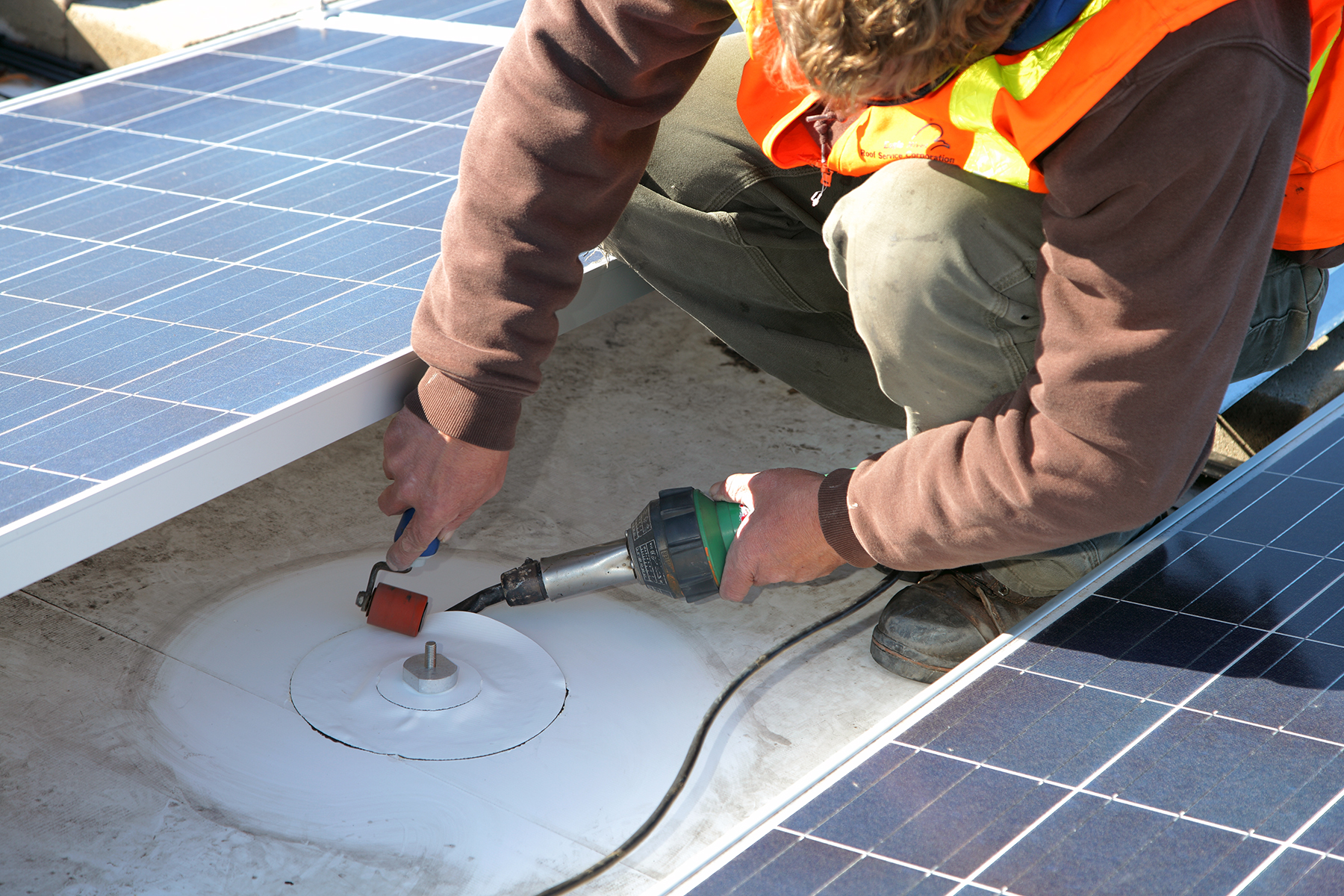
Membrane chemistry decides what is even allowed. TPO and PVC are thermoplastics, so we can hot-air weld a target patch around a standoff and know the detail is monolithic with the field sheet. EPDM is cured rubber that gets patched with adhesives and cover tape, so a sloppy crew can leave a penetration that passes a glance and weeps a season later. Built-up and modified-bitumen roofs raise their own ballast-load and torch-detail questions. A large part of our pre-construction work is telling the solar EPC exactly which racking details their vendor is permitted to use on your specific membrane.
Weight, Uplift, and Llano Estacado Wind
Lubbock is one of the windiest cities in the country, averaging better than sustained gusts across wide-open terrain that offers nothing to slow them. Wind is not a footnote on a rooftop array here; it is the governing load. Two structural questions have to be answered before we sign off on any attachment method. First, can the deck and framing carry the added dead weight, especially under a ballasted layout where blocks may add several pounds per square foot across the entire field? A lot of the older mid-century stock around the central city was designed to lighter load standards and lacks that reserve. Second, will the array stay anchored when the wind builds? Tilted modules behave like airfoils, and an under-ballasted or under-anchored row will lift, slide, and tear the very membrane it was meant to shelter.
Drainage is the third factor and the one most often ignored. An array reroutes how water and the blowing grit and dust of the plains move across a roof. Ballast blocks and racking feet form dams that pond water and pile up debris if the layout fights the slope-to-drain. We check the panel layout against the roof's crickets and tapered insulation so the array does not turn a well-draining roof into a grid of small ponds, each one parked over a penetration.
Warranty Coordination Between Roofer and Solar Installer
This is the seam where projects quietly fail. A manufacturer's no-dollar-limit membrane warranty can be voided the instant an unapproved party drives fasteners or foreign attachments through the roof. The solar installer is focused on production and string design and is not tracking your roofing coverage. We are. Before any work starts we bring the membrane manufacturer into the conversation, confirm the proposed attachment details and walkway protection are on their approved list, and set up the warranty inspection that keeps coverage alive after the array energizes.
Conduit is the detail that gets botched more than any other. Runs from the array to the building's service have to cross the roof somewhere, and conduit strapped flat to the membrane abrades it under thermal movement while generic boot flashings at conduit penetrations turn into dependable leak points. We require raised, blocked conduit supports and properly flashed penetrations, and we insist the roofing crew flash those openings rather than the electricians. Nail the sequence and the responsibilities and you finish with one roof, one array, and two warranties that both still mean something.
How We Run a Solar-Ready Roofing Project in Lubbock
We do not sell solar systems, and that independence is the entire point. Our only stake is a roof that keeps the building dry for its full design life with an array sitting on top of it. If you are weighing PV for a property anywhere from the Texas Tech-area developments to the industrial blocks south of the loop, talk to us about the roof before you put a signature on the solar contract.
Solar Roof Integration Questions
Should we reroof before installing solar or mount it on the existing roof?
It hinges on documented remaining service life. With fifteen or more years left on a sound membrane, installing onto the existing roof is reasonable. With seven or fewer, reroofing first almost always beats detaching and resetting the array during a future tear-off. We provide the service-life estimate so the call rests on evidence.
Do the racking feet have to penetrate the membrane?
Not always. Ballasted systems hold the array down with weighted trays and skip penetrations, common on Lubbock's flat roofs where the structure can carry the load. Where wind exposure or deck capacity rules out ballast, mechanically attached standoffs are used and each one is individually flashed to the manufacturer's detail.
Will adding solar void my roof warranty?
It can, if an unapproved attachment goes through the membrane without manufacturer sign-off. We bring the membrane manufacturer in during pre-construction, confirm the racking and flashing details are on their approved list, and schedule the warranty inspection so coverage survives the install.
Can the deck handle the added weight and the wind out here?
That is exactly what we verify before approving an attachment method. Ballast adds dead load older buildings may lack reserve capacity for, and tilted modules generate serious uplift in Lubbock's sustained winds. We coordinate with the structural engineer and the racking manufacturer's wind certification for the site's actual exposure category.
Who flashes the conduit penetrations, the roofer or the electrician?
The roofing crew should. Conduit penetrations sealed with generic boots or left to the electricians are a frequent leak source. We require raised, blocked conduit supports and properly flashed openings, and we assign that responsibility in the pre-construction meeting.
Next Step
Send the building address, roof age if known, leak photos or condition photos, roof access notes, tenant limits, and the decision timeline. We will shape the roof walk around roof evidence, access limits, weather exposure, and budget timing and return a practical scope tied to what can be verified.